

Environmental Product Declarations (EPDs)
What it is: A certified, third-party verified summary of an underlying LCA that follows relevant ISO rules. The practitioner performs the LCA and writes a background report for the verifier, then publishes a short public EPD where sensitive business details are removed.How EPDs are governed:
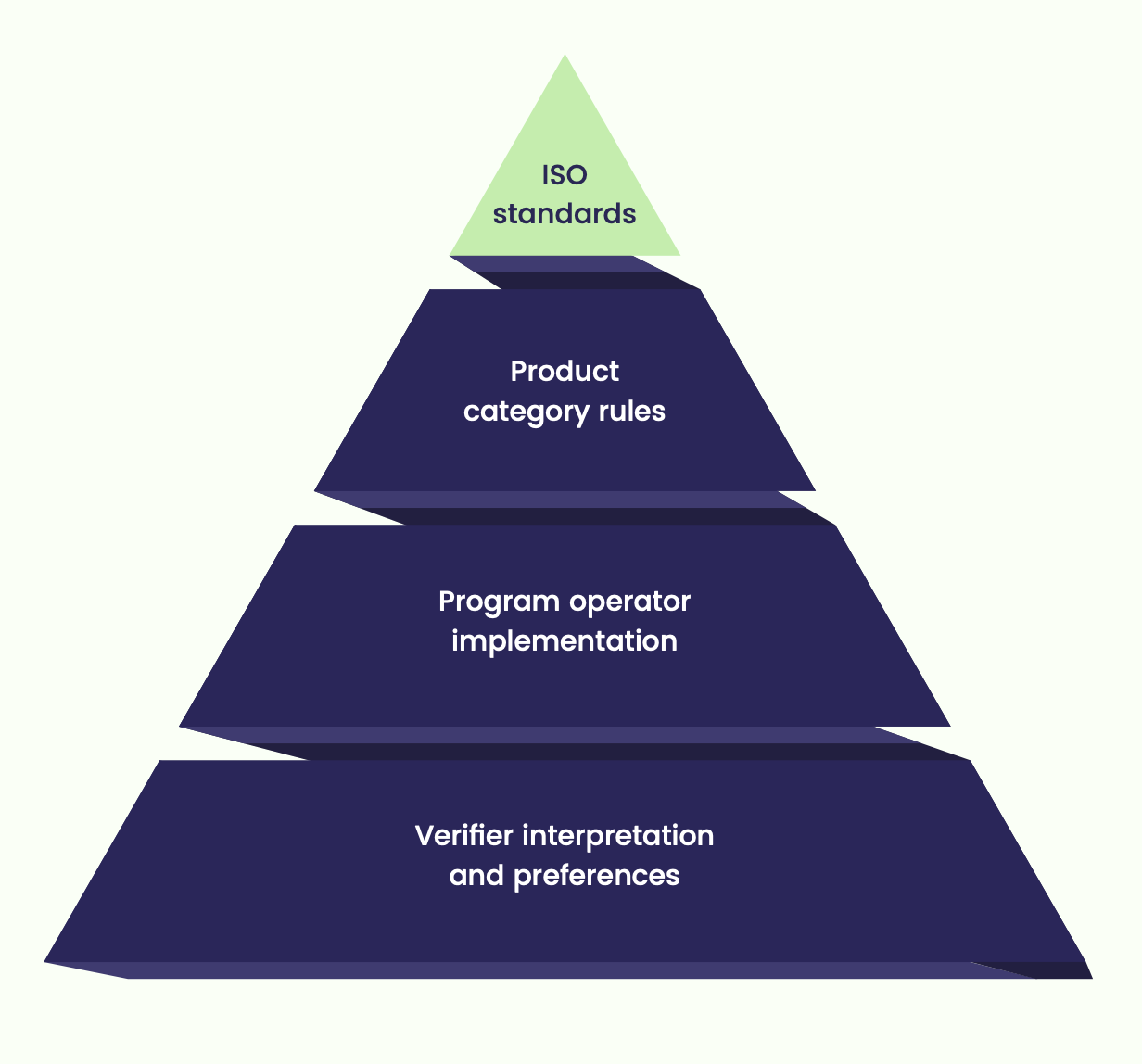
- ISO 14025 sets the umbrella rules for Type III environmental declarations.
- Product Category Rules (PCRs) translate the general rules into product-specific methods.
- Program operators implement the scheme, and independent verifiers check conformity.
Because multiple interpretation layers exist, EPDs can vary in practice.
How to use EPDs well:
- Treat EPDs as strong data points, not absolute truth. LCA is interpretative, and two competent studies on the same product can land on different numbers even after verification. Use EPDs to inform decisions rather than to run head-to-head comparisons across brands without deeper context.
Product Environmental Footprint (PEF)
What is PEF?
The EU’s framework to harmonise product assessments, improve comparability inside categories, and raise transparency for buyers. PEF is part of the EU Green Deal and the Circular Economy Action Plan. Why it matters now: The EU is phasing PEF into policy with timelines tied to ESPR. Expect more PEF Category Rules (PEFCRs) and progressive adoption for priority product groups. Use PEF when you need EU-aligned, multi-indicator results with clear comparability inside a category. Here’s what we know about the timeline as of today:1
2013-2018
Pilot phase for developing and testing the methodology in 27 product categories.
2
2020-2023
Finalisation of methodologies and stakeholder consultations.
3
2024-2025
Adoption of ESPR and supporting legislation.Expansion of PEFCRs for additional product categories.
2026 Onwards
Mandatory implementation of PEF for specific productgroups, beginning with those covered under the ESPR.
Digital Product Passports (DPPs)
What are DPPs?
A digital, standardised card that surfaces lifecycle and supply-chain data for a product, similar in spirit to how an EPD summarises a long background report. DPPs aim to make verified product data accessible in markets that demand traceability. What to expect: The details are evolving, but policy points to adoption under ESPR with rollouts across high-impact product groups such as electronics, batteries, and textiles, plus full battery implementation by 2027 under the Battery Regulation. Start preparing primary data flows now to avoid a future scramble.Allocation Frameworks in Declarations
Most declarations use attributional modeling, which totals the direct contribution of a product across its stages. In Europe, EN 15804 is a key allocation framework for construction-related EPDs. One notable feature is how it credits future recycling in end-of-life modelling. Consequential modeling is more common in policy and large infrastructure analysis. Implementation Timeline:1
2024-2025
Adoption of ESPR, including the mandatory introduction of DPPs for priority product categories.Further development of technical and data-sharing standards.
2
2026-2028
Progressive rollout of DPP requirements starting with high-impact product groups (e.g., electronics and batteries and textiles).Full implementation of DPPs for batteries by 2027 under the Battery Regulation.
2030 Onwards
DPPs likely extended to cover a broad range of products and integrated into global sustainability frameworks.
EPD vs PEF vs DPP – How to Choose
- Need a concise, verified public proof for one product for tenders or buyer requests – publish an EPD based on a robust LCA. Be careful with cross-brand comparisons unless the underlying rules and scopes match closely.
- Need EU-harmonised comparability within a product category and alignment with upcoming policies – build to PEF and its PEFCRs.
- Need to expose product lifecycle and supply-chain data in a standardised digital format for compliance and market transparency – prepare for DPP integration and data provisions.
Quality Checklist for Credible Declarations
- Clear goal and scope that match the intended use of the declaration.
- Declared or functional unit defined and justified.
- Named method appropriate to the context, for example EF 3.1 for EU-aligned multi-indicator results.
- Transparent data sources and database choices explained.
- Allocation rules stated, for example EN 15804 for construction EPDs.
- Verification path documented if publishing an EPD or making public comparisons.
Practical Takeaway
Communicate credibly today and get future-proof for EU requirements
- Use EPDs when you need a concise, verified public document.
- Use PEF to align with EU policy and to compare inside a category.
- Prepare for DPPs by structuring primary data across your product and supply chain now.
This combination lets you communicate credibly today while getting future-proof for EU requirements.